Loading...
Serving Alameda, CA and surrounding areas. (341) 895-9185
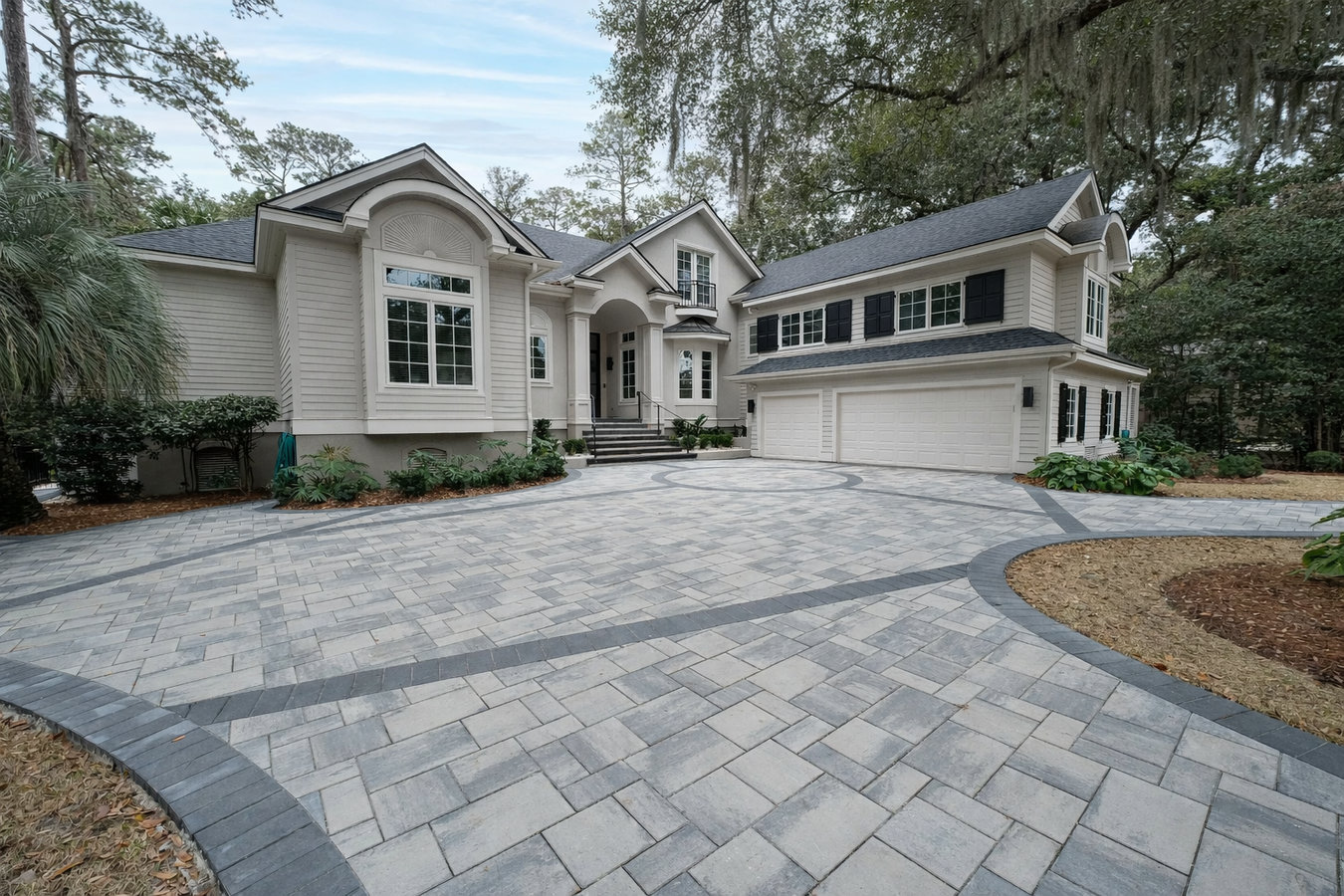
Your driveway cracks because the ground moves. Pavers are designed to move with it - and when one piece needs replacing, you swap it out without touching the rest.
Driveway pavers in Alameda involve removing your existing surface, preparing a deep, compacted base suited to Bay mud soils, and setting individual paver units that can each be replaced if damaged. Most residential jobs take two to five days from demolition to driving on the finished surface.
If your current driveway cracks the same spots every year, the problem is underground - the surface is just where the symptom shows up. Pavers work better in Alameda than poured concrete because they flex with the seasonal ground movement that comes with clay-heavy Bay fill soils, rather than cracking across a rigid slab. Many homeowners pair their driveway project with walkway construction so the front entry is finished as a single, cohesive hardscape.
Alameda also has stormwater runoff requirements that affect how driveways are designed. A contractor who knows these rules will design your driveway with drainage that satisfies the city and protects your foundation. The San Francisco Bay Regional Water Quality Control Board publishes homeowner guidance on stormwater standards for residential paving projects.
If you have patched the same cracks more than once and they return in the same spots, the issue is in the ground beneath the surface, not the concrete itself. In Alameda, clay-heavy Bay fill soils expand and shrink with the seasons, and that movement is exactly what splits a rigid slab. At some point, patching stops being cost-effective.
Standing water that does not drain within an hour or two after rain means your surface has settled unevenly or drainage was never properly designed. This is a real concern in Alameda, where winter rains can be heavy and the flat terrain in many neighborhoods does not naturally shed water. Pooling water also accelerates surface wear and can migrate toward your foundation.
When a concrete driveway starts to flake off in thin layers at the edges - called spalling - it has reached the end of its useful life. Salt air from the Bay speeds this up in Alameda, particularly on driveways that were never sealed. Once spalling starts, it tends to spread, and no amount of patching will stop it.
If you are already planning to update landscaping, add a garage, or renovate your front yard, addressing the driveway at the same time makes sense. One mobilization, one period of disruption, and a finished result where everything belongs together is always better than doing the driveway separately and disturbing finished work later.
We install concrete, brick, natural stone, and permeable paver driveways across Alameda and the East Bay. Every project starts with the same foundation: excavation to the right depth, compacted aggregate base layers, and a drainage plan matched to your property. The surface material you choose sits on top of that foundation - and it is the foundation that determines how the driveway performs ten years from now.
Many homeowners in Alameda combine a paver driveway with retaining wall construction when a sloped yard needs to be graded before the driveway can be properly leveled. We also regularly pair driveway work with walkway construction so the entire entry sequence - from street to front door - is finished in matching materials at the same time.
The most popular choice for Alameda homeowners - concrete pavers come in a wide range of colors and patterns and hold up well against Bay area salt air.
A natural fit for the Victorian and Craftsman homes common throughout Alameda, brick pavers bring a classic look that complements older architecture.
Bluestone, granite, and travertine options suit homeowners who want a premium, high-end finish and a surface that is genuinely one of a kind.
Designed for properties where stormwater management is a priority, permeable pavers let rainwater filter through the surface rather than run off.
Alameda sits on an island in San Francisco Bay, and the ground here is not like the solid hillside soil you find in Oakland or Berkeley. Much of the island was built on Bay fill and bay mud - soft, compressible material that moves as moisture levels change. A poured concrete slab has no give, so when the ground beneath it shifts, the slab cracks. Pavers are individual units designed to move as a system, which is why they hold up on this kind of ground in a way that solid concrete does not. The salt air from the Bay is also harder on unsealed surfaces than most homeowners expect, which is why we seal every driveway we install.
We serve homeowners across the island, from the Victorian neighborhoods near Park Street to the newer properties at the west end. Neighbors in San Leandro and Oakland face similar Bay-adjacent soil and drainage conditions, and we bring the same approach to base preparation and drainage design to every project we take on in the East Bay.
Reach out by phone or the contact form and we will follow up within one business day. Have a rough sense of your driveway size and what is currently there - that helps us arrive prepared.
We visit your Alameda property, measure the driveway, check drainage and soil conditions, and walk you through material options. There is no cost and no pressure to decide on the day.
If your project requires a city permit, we prepare and submit the application. Budget a few extra days for permit processing - we keep you updated so nothing stalls.
The crew removes the old surface, prepares the base properly, and sets your pavers. Before we leave, we walk you through the finished driveway and leave you with care instructions.
Free on-site estimate. We handle permits. No pressure to decide on the day.
(341) 895-9185Alameda sits on Bay mud and fill that expands and contracts with the seasons. We account for this by using deeper, more carefully compacted base layers than you need on stable ground. That is what keeps pavers level and tight years after installation.
We pull all required permits from the City of Alameda Planning and Building Department and coordinate the inspection. You never have to call the permit office yourself. The Interlocking Concrete Pavement Institute sets the installation standards we follow.
Living on the Bay means salt air works on unsealed surfaces faster than most homeowners expect. We seal every driveway we install and walk you through a simple maintenance schedule so your pavers hold their color and resist staining for the long run.
Our estimates break out base preparation, materials, and labor as separate line items so you can see exactly what you are paying for. That makes comparing quotes from other contractors easy and honest.
Every one of these points comes down to the same thing: doing the work correctly the first time so you do not end up calling someone to fix it two years later. That is the standard we hold every project to, from the first estimate to the final walkthrough.
The Interlocking Concrete Pavement Institute publishes installation standards and homeowner guidance on what quality paver work should include. The California Contractors State License Board lets you verify any contractor license in seconds before you hire.
A retaining wall combined with a new driveway creates a finished, cohesive hardscape that adds function and curb appeal at the same time.
Learn MoreCoordinate your paver driveway with a matching walkway so your front entry has a unified look from street to door.
Learn MoreSummer booking slots fill fast - reach out now and lock in your project before the best crews are taken.